Repairs · London
Garage Door Bottom Seal Replacement
The gap under the door is a finger wide at one end and nothing at the other. The door itself looks straight, but the floor drops away toward the corner where the slab has settled, and drafts pour through the wedge.
Garage Door Bottom Seal Replacement
In plain words
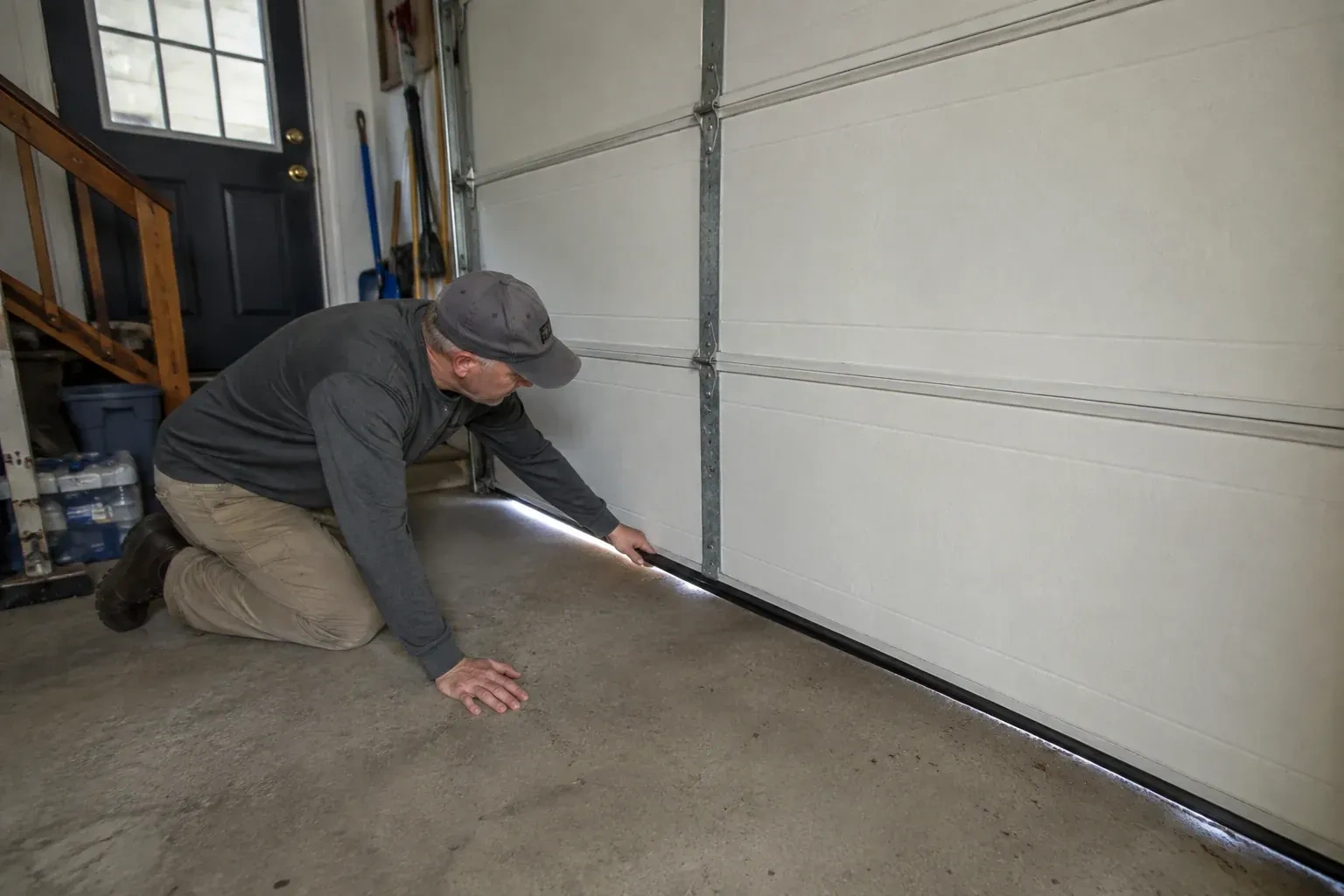
A seal visit runs in a set order. With the door closed, the technician looks for daylight along the floor line and notes whether the gap is even or concentrated at one point. The door is checked for level and the bottom section for straightness, then the retainer is identified and measured. The opener is disconnected and the door secured before the old strip comes out and the channels are cleaned. A new seal, cut a little long, is fed into the channels and trimmed. Finally the door is closed onto the new seal, the opener's limits are reset, and the reversing test is run before the tools go away.
How the visit goesWith the door closed and the lights off, a bright line of daylight runs along the floor from one side to the other. Leaves and grit have blown in under it and gathered in a neat drift against the back wall.
London
How the visit goes
Reading the gap with the door closed
The assessment starts with the lights off and the door down. From inside, the technician looks along the floor line for daylight and notes where it shows: a thin line the full width, a wedge at one corner, or a patch in the middle. A straightedge laid across the threshold shows whether the slab is flat or dished, and a hand run along the seal feels where it touches and where it hovers. Photographs of the worst spots are taken so you can see what is being fixed. This map of the gap tells the technician how tall the new seal needs to be and whether anything other than the seal is contributing.
Adding a threshold seal on a difficult floor
Where the slab slopes toward the garage or has a dished edge, a threshold seal glued to the floor follows the existing contour and gives the bottom strip a raised, consistent edge to meet, rather than levelling the floor itself. The floor line is marked with the door closed, the concrete is swept and cleaned for the adhesive, and the threshold is dry-fitted and trimmed against each jamb. Adhesive is laid along the underside, the threshold pressed down, and the door lowered onto it while it sets. The result is a small raised lip on the outside that turns water back to the driveway and a bottom seal that lands on a consistent edge along its length.
A record of the profile and size
Before leaving, the technician tells you what went on the door: the seal profile, whether T, bead or bulb, its width and height, the material, the door width it was cut for, and whether the retainer was renewed. Write this on a card by the opener or inside the manual. Bottom seals wear out on a schedule of years rather than decades, and knowing the profile means the next one can be ordered and fitted without measuring from scratch. If a threshold seal was added, its length and type belong on the same card.
Garage Door Bottom Seal Replacement
In the van
- Nail-on vinyl strip for wood doors
- Seal end caps
- Aluminum bottom seal retainer
- Straightedge and tape measure
- T-style bottom seal
What affects the quote
Same fees day, night or weekend
1Opener adjustment
Resetting the down limit and force and repeating the reversing test after a taller seal is fitted is a short step that the quote names whenever the door has an opener.
2Access and clearance
Storage, a vehicle that must stay inside, or shelving against the bottom of the door slows the work. A clear metre inside the door makes the visit shorter.
3Seal profile and size
T-style, bead and bulb profiles in different widths and heights sit at different points on the parts list, and the retainer on your door decides which one is used.
Garage Door Bottom Seal Replacement: questions
What are bottom seals made of, and which suits cold weather?
Most are vinyl, which resists sun and moisture well but stiffens in deep cold. Rubber compounds stay flexible at low temperatures and follow an uneven floor closely, though they can harden after many years of sun. Silicone stays supple in heat and cold and resists cracking, at a higher cost. For a door that faces the weather, a rubber or silicone profile is usually the sounder long-term choice.
The seal looks fine, so why is there still daylight under the door?
A seal can look intact and still have taken a permanent set, so the bulb no longer springs up to fill the gap. Otherwise the gap belongs to something else: a door hanging out of level, a bowed bottom section, a floor that has settled at one end, or an opener down limit set so the door stops short. The first look during the visit sorts these apart so the fix goes to the right place.
Can the seal be replaced in the middle of winter?
Yes, and winter is when most people notice they need one. Vinyl is stiffer in the cold, so the technician keeps the new roll warm until it is fed and takes a little longer working it across the channels. A seal frozen to the floor is freed by hand first. The door is then closed onto the new strip and the opener reset exactly as in summer, and the garage is sealed for the rest of the season.
Repair & Maintenance
- Garage Door Tune-UpTwice this week the door started closing, stopped a metre from the floor and reopened on its own.
- Off-Track Garage Door ResetYour car is inside and the door is stuck crooked across the opening.
- Garage Door Panel ReplacementYears of slap shots have peppered the lower two sections with dents.
Garage Door Bottom Seal Replacement near you
Every garage door service we offer in London is described the same way: what you might have noticed, what the technician checks first, how the work is done and what you have afterwards. Start with the symptom you are seeing and the right service will be easy to find.